
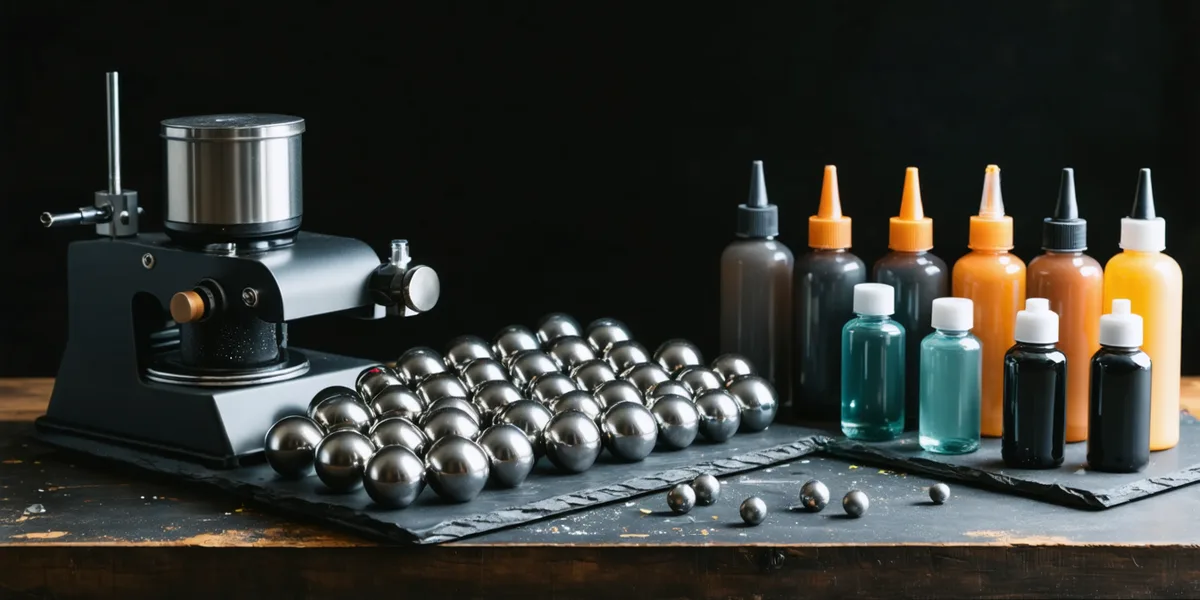
Most paints that "don't cover properly" are not bad paints. They are separated paints, painted straight off the top of the pot. Fixing that costs the price of a bag of little steel balls, and the machines everyone argues about are an accelerator on top of it - a real one, but only once you own enough pots for shaking to become a chore. Here is what separates, what each tool actually does about it, and which of them will grip the pots you own.
Why paint separates, and what it costs you
Acrylic miniature paint is pigment suspended in a binder and water. Pigment is heavier than what carries it, so it sinks - slowly in a pot you use weekly, completely in one that has stood on a shelf since last winter. What you see when you open it is the light stuff: binder, water, flow improver.
Paint from that top layer goes on thin, slightly glossy, and covers like coloured water. Two coats become four, the model looks patchy under a lamp, and the natural conclusion is that the paint is weak. Paint dredged from the bottom of the same pot has the opposite problem - over-pigmented, chalky, and gritty enough to fill detail.
Three kinds of paint punish this hardest:
- Metallics. Metallic flake is by far the heaviest thing in the pot and settles fastest. Paint the top of an unmixed metallic and you are brushing on clear binder holding almost no flake, which is why a gold can look dull and streaky and then look perfect twenty seconds of shaking later.
- Contrast and speedpaints. These are deliberately high-medium and low-pigment, so the ratio between the two is the whole product. Get it wrong and the paint either dries as a shiny film with no shade in the recesses, or grabs and dries mid-stroke. See our contrast paint guide.
- Washes and shades, for the same reason.
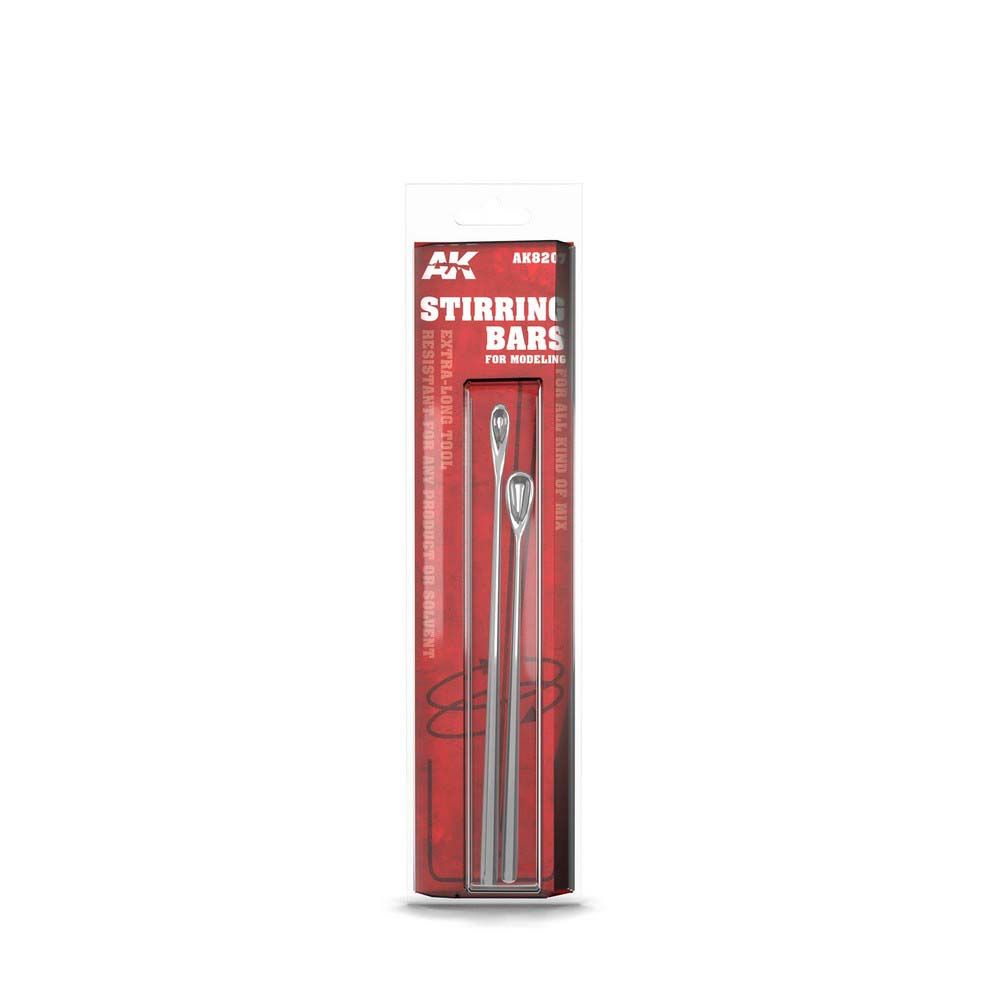
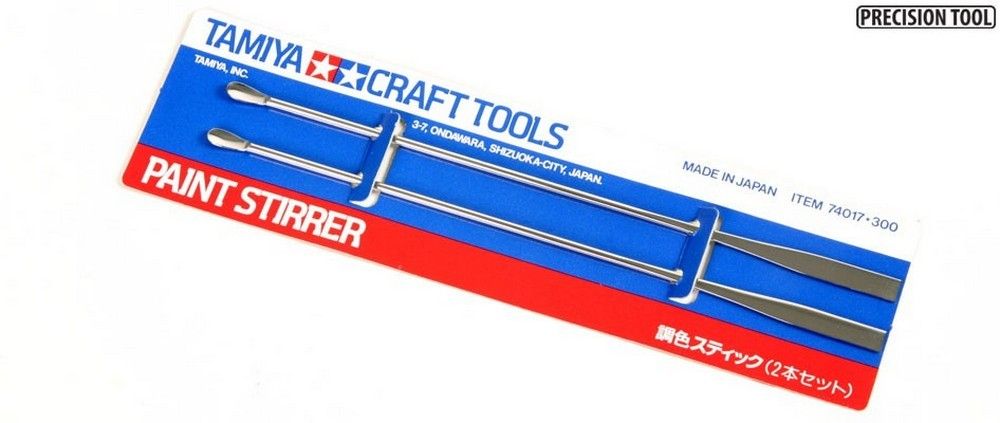
The other half of the problem is not settling but a plug - a dense cake of dried and compacted pigment welded to the bottom of a long-neglected pot. No amount of shaking lifts a plug. You have to break it up with something rigid first: a stirring bar such as AK's modelling stirring bars or a Tamiya paint stirrer, then shake. Machines are no help at all with this, and it is worth knowing before you buy one and find it did not fix the pot you bought it for.


Hand shaking, agitator balls, machines
By hand is genuinely fine. Thirty to sixty seconds of hard shaking, with the pot inverted for part of it, mixes almost any paint that has not plugged. It costs nothing. It just does not scale: fifteen pots into a session it is a chore, and a chore is a thing people skip.
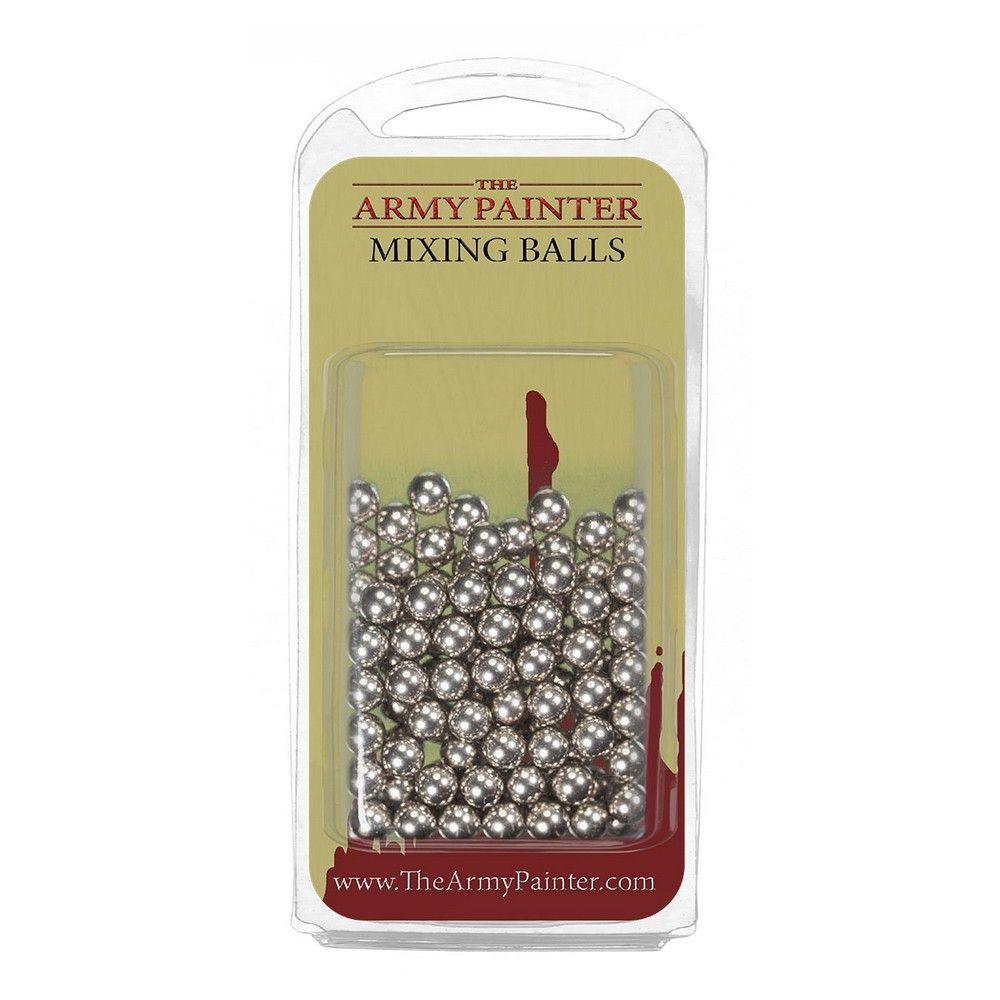
Agitator balls are the actual answer for most painters, and the cheapest thing on this page. A steel or glass ball living permanently in the pot turns a lazy five-second shake into a proper mix. Whether you buy a machine or not, buy these - the whole shelf of balls, stirrers, shakers and empty bottles is at paint mixers and shakers, priced against the shops we track.
Electric shakers clamp or grip the pot and vibrate it, usually for a set cycle of a minute or two. We hold two: the mains-powered Green Stuff World Paint Shaker Machine, a compact benchtop unit with suction-cup feet so it stays put, and the cordless USB-charged Green Stuff World Rotational Paint Shaker, which ships with three adaptors at 15, 22 and 30mm. Those adaptor sizes are not trivia - they are the specification that tells you what the machine will actually hold.


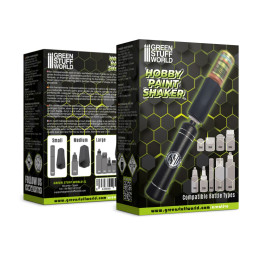
Cordless rotational paint shaker with 3 bottle adaptors
Green Stuff World
Vortex mixers come from laboratory kit, not the hobby. You press a bottle down onto a rubber cup head that orbits at high speed - excellent with tall dropper bottles, awkward with squat pots, and because they spin the contents rather than throwing them about, they still want a ball in the pot to reach a settled bottom layer. The Vortex-Genie is the famous one and we do not stock it; the generic laboratory units sold for a fraction of that are what most painters end up with.
Nail polish shakers are the crossover everyone eventually discovers: varnish separates in exactly the same way, and the nail industry solved it first with cheaper, sturdier machines than the hobby ones. They clamp a bottle between two plates and shake hard. We do not stock any, and saying so is more useful than pretending otherwise - but if you go looking, the plate gap is the only spec that matters, and most are built around tall, slim varnish bottles.
Which machine grips which pot
This is the question that decides the purchase, and almost no product page answers it.
- Dropper bottles - Vallejo, Army Painter Warpaints, Pro Acryl, AK - are the easy case. They are tall, narrow and screw-capped, which suits vortex heads, nail-polish clamps and adaptor rings alike. The 15-22mm end of an adaptor set is aimed squarely at them.
- Citadel pots are the hard case. They are wide, squat, flat-bottomed and close with a hinged lid rather than a screw cap. A clamp built for a slim bottle will not close around one, a vortex head cannot get purchase on that footprint, and - the failure that costs you a pot - a lid that was not clicked fully shut will open under vibration. Check the lid, every time, before the machine goes on.
- Tamiya and AK jars and 30ml pots sit in between and are usually the reason a 30mm adaptor exists.
- The permanent fix for a collection you keep hitting this with is to stop fighting it and decant: empty 17ml dropper bottles supplied with mixing balls or AK's Mix And Ready jars turn awkward pots into the format every machine handles.
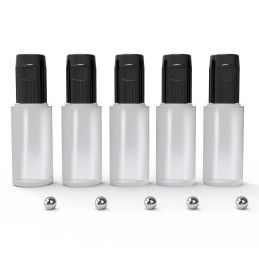
Empty 17ml dropper bottles supplied with steel agitator balls
Green Stuff World
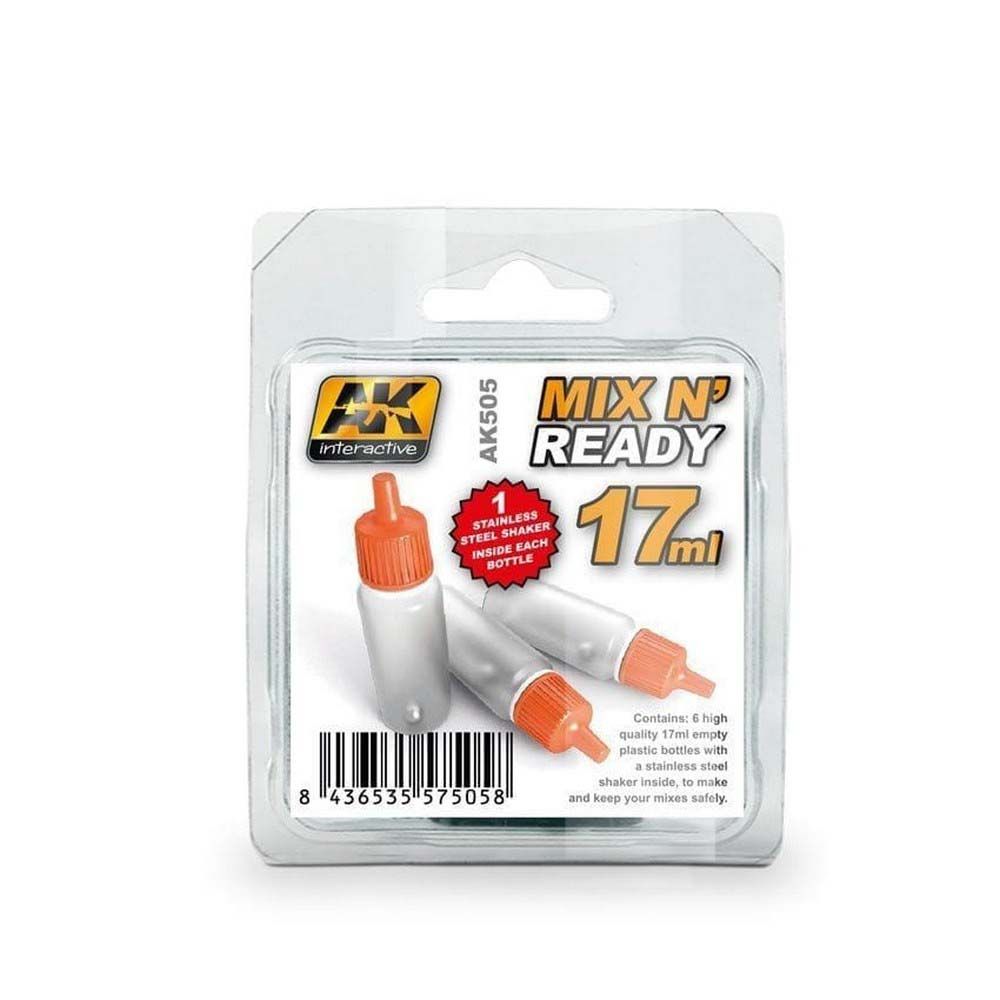
Six empty 17ml jars with agitator balls for your own mixes
AK Interactive
Agitator balls: steel or glass, and how many
Size is set by the neck, not by preference. A ball that will not pass the neck of a dropper bottle is useless, and one too small to shift much rattles around a Citadel pot doing very little. In practice:
- 8mm for Citadel pots and larger jars - Green Stuff World's 8mm stainless.
- 5 to 6.35mm for dropper bottles - Green Stuff World's 6.35mm, Army Painter's 5.5mm, or the Monument Hobbies 5mm green glass agitators sized for Pro Acryl.
- If you are doing the whole collection in one sitting, a bulk bag such as AK's 250-ball pack is the sane way to buy them.
Stainless versus glass is the argument you will find in every forum thread. The honest position:
- Stainless steel is denser, so it mixes harder for its size, and it is what most painters use in most pots without incident. The corrosion stories almost always trace back to cheap chrome-plated or carbon-steel bearings rather than real stainless - plating chips, the metal beneath rusts, and you get specks in a pale colour where they show worst.
- Glass is inert. It will not oxidise, it will not react with solvent-based or lacquer paints, and it cannot contaminate a white or a pale flesh tone. Green Stuff World's 8mm glass and Monument's green 5mm are the two we hold, and Green Stuff World sell theirs specifically on resisting solvent degradation and oxidation.
- The metallics claim - that a steel ball batters metallic flake and dulls the finish, where glass is gentler - is widely repeated and thinly evidenced. It is also nearly free to act on, since the two sit in the same bracket on the shelf: if you paint a lot of metallics, put glass in those pots and stop thinking about it. The one real trade is that glass is lighter, so it mixes a little less energetically than steel of the same size.
How many. One ball in a dropper bottle, two in a Citadel-sized pot. Two beat one noticeably; three rarely beats two, and every ball you add displaces paint - drop a handful into a full pot and it will overflow when you close the lid. Wipe the rim before shutting it, or the lid will seal itself over the next month.
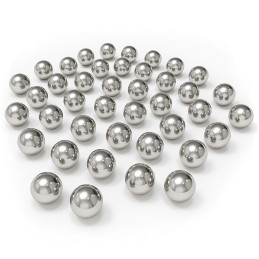
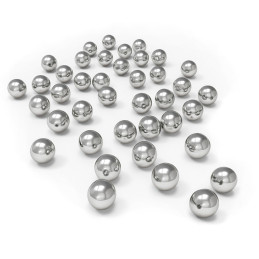
Stainless agitator balls, 6.35mm — dropper-bottle size
Green Stuff World
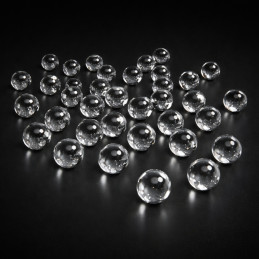
Glass agitator balls, 8mm — for solvent-based paints
Green Stuff World
When a shaker is worth buying
- Worth it: a collection past a hundred pots; a shelf of contrast and speedpaints, where a bad mix ruins the one thing you bought them for; a lot of metallics; or paints that stand unused for months between projects.
- Not yet: twenty pots you paint with every week. Buy balls, spend the difference on paint, and revisit it when shaking has become the part of setting up that you dread.
The order that actually saves money is balls first, machine later. Balls fix the mixing; a machine only makes the fixing faster.
Tips
- Break a plug before you shake it - a stirring bar first, then the ball does the rest. A machine will not lift compacted pigment off the bottom.
- Let shaken paint rest a minute. Hard mechanical shaking whips air into high-medium paints, and painting a foam gives you bubbles that pop into pinholes as they dry.
- Check a Citadel lid is fully clicked shut before any machine touches it.
- Use glass in your metallics and your whites, steel everywhere else, if you would rather not think about it again.
- Two balls in a pot, one in a dropper - and mind the displaced volume in a full pot.
- Do the whole collection in one sitting. Balls go in once and work forever; a half-done collection is the one you will keep being caught by.
Shop paint mixers and shakers
Agitator balls are the cheapest real upgrade in miniature painting - buy those first, and a machine only when shaking has become a chore.
We earn a small commission from qualifying purchases at no extra cost to you.