
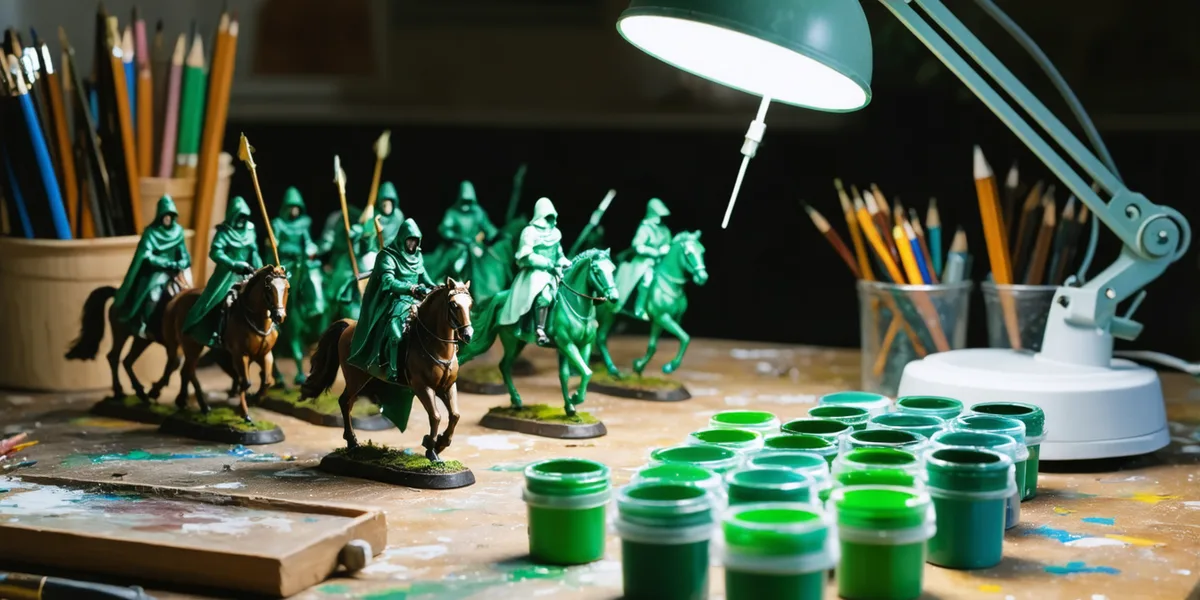
Games Workshop's own Middle-earth paint sets are long discontinued, which leaves anyone starting a Rohan or Mordor force with the same problem: the schemes are famous, the shopping list is not. Ask what paints you need for Lord of the Rings miniatures and the internet hands you a forum thread from 2013 and a photo of a pot that no longer exists.
This page is the shopping list. Every faction below gets the colours the scheme actually needs, named as specific pots you can put in a basket, with a Vallejo or Army Painter equivalent alongside each Citadel colour so you are not held hostage by one range. The recipes are sourced - mostly from Games Workshop's own Middle-earth painting articles, backed up with well-known community walkthroughs - and where the sources disagree with each other, which happens more than you would expect, this guide says so instead of quietly picking one.
A note on scope: we do not sell Middle-earth miniatures and this is not a rules guide. It is a paint guide, and the paints are the part everyone gets stuck on.
The Middle-earth palette in one paragraph
Middle-earth is a muted setting. Almost everything - Rohirrim, Gondorian soldiery, orcs, goblins, Uruk-hai - is built from earth browns, drab greens, iron and leather, with one saturated accent per faction: green for Rohan, black-and-silver for Gondor, gold for Lórien, blue for Rivendell. That means a single core of about eight pots covers four or five armies, and the faction identity costs two or three more. It is genuinely one of the cheapest games to paint, and the reason is that the whole range lives or dies on a brown wash. Buy the biggest one you can.
- A brown shade - Agrax Earthshade or Strong Tone. Used on every model in this guide, without exception.
- A black shade - Nuln Oil or Dark Tone, for armour and mail.
- A dark steel - Leadbelcher, Gunmetal or Gun Metal.
- Two leathers - a dark chocolate and a mid tan: Rhinox Hide with Cygor Brown, or Leather Brown with Oak Brown.
- A dusty buff - Zandri Dust or Iraqi Sand. It doubles as an undercoat for every mortal faction here.
Citadel (Warhammer Paints)
Citadel (Warhammer Paints)
Army Painter
Vallejo
Vallejo
If you would rather see how a range compares before committing, the best miniature paints comparison covers Citadel against Vallejo and Army Painter on coverage, pot size and price per ml.
Rohan - green cloaks over dust and leather
Rohan is the friendliest force in Middle-earth to paint, because the scheme was designed to be batch-painted. The Rohirrim are dusty leather and drab cloth with a green cloak and a little silver; nothing on the model needs to be clean.
Games Workshop's own Rohan battlehost walkthrough on Warhammer Community builds the whole force from a Zandri Dust undercoat: Cygor Brown for the dark leather, Dryad Bark thinned with medium for the lighter straps, a 1:1 mix of Dark Angels Green and Caliban Green for the cloaks, Tuskgor Fur thinned for skin, Iron Hands Steel for silver and Retributor Armour for gold - then Agrax Earthshade over the lot and a Karak Stone drybrush along the bottom of the cloaks and leathers for road dust. That last step is what makes them look like cavalry rather than toy soldiers.
An older Games Workshop Rohan article goes further and designs the scheme around the wash - every colour chosen so that one coat of brown shade over the entire model finishes it. If you have thirty riders to paint, that is the method to copy.
- Cloaks: the mixed dark green above, or Deathworld Forest straight from the pot for a lighter, mossier cloak. Vallejo painters want Olive Green; Army Painter's nearest is Army Green.
- Cloth and tunics: Iraqi Sand or Zandri Dust, shaded brown.
- Mail and helms: Leadbelcher, Nuln Oil, then a light Ironbreaker drybrush.
- Shield devices: an off-white - Ushabti Bone or Brainmatter Beige - kept slightly warm, never pure white.
Citadel (Warhammer Paints)
Citadel (Warhammer Paints)
Citadel (Warhammer Paints)
Citadel (Warhammer Paints)
Vallejo
Army Painter
Horses, which are half the army
A Rohan force is mostly horse, and horses are where people stall. The same Games Workshop walkthrough splits them three ways: whites get a White Scar undercoat and a thinned Gryph-Charger Grey glaze into the recesses; blacks get a Zandri Dust undercoat and Black Templar over the top; bays and browns get thinned Dryad Bark. All the tack is one leather colour. Three horse recipes, four pots, and a cavalry force that reads as a real herd rather than a colour swatch.
Citadel (Warhammer Paints)
Citadel (Warhammer Paints)
Citadel (Warhammer Paints)
Citadel (Warhammer Paints)
Vallejo
Army Painter
Gondor - steel, black cloth and the white city
Gondor is the faction with two legitimate looks, and choosing between them is the whole decision.
The field army look - Warriors of Minas Tirith as they appear on the walls - is dark steel plate over black cloth, with the tree device and a little gold. Community walkthroughs of the plastic warriors converge on Leadbelcher for the plate and spear, a black shade in the recesses, Ironbreaker on the raised metal, Abaddon Black for the skirt, gloves, boots and shield with Dark Reaper picking out the folds, Rhinox Hide for belts and shafts, and Balthasar Gold for the shield boss, sword hilt and the tree itself. It is a fast scheme: three quarters of the model is two colours.
The parade look leans on the city instead of the soldier - pale stone-white armour and heraldry, which Games Workshop's own Minas Tirith showcases build from a Grey Seer spray angled from above so the recesses stay in shadow, then re-highlighted towards white. It photographs beautifully and it is considerably harder; white is the least forgiving colour in the hobby.
- Black cloth done properly: never leave it flat black. Fold highlights in Dark Reaper or Uniform Grey, with a cold blue-grey for the sharpest edges, is what stops Gondor looking like a silhouette. See edge highlighting for the technique.
- Vallejo route: Black Grey for the cloth, Natural Steel for plate, Old Gold for the tree.
- Army Painter route: Plate Mail Metal, Matt Black, Bright Gold.
Citadel (Warhammer Paints)
Citadel (Warhammer Paints)
Vallejo
Mordor - grime, iron and one red accent
Mordor is the least demanding army to paint well in any game we cover, and the reason is that the target look is dirt. Games Workshop's showcase of a large Mordor collection describes exactly the approach that works: a small number of dark colours - Dryad Bark, Rhinox Hide, Skavenblight Dinge and Mechanicus Standard Grey - spread randomly across cloth, leather and armour plates so no two orcs match, all shaded with Agrax Earthshade, then highlighted with a bone tone such as Screaming Skull or Karak Stone. A single Khorne Red accent on a rag or a banner, highlighted towards Kislev Flesh, supplies the only colour on the model.
Independent community recipes for Mordor orcs add the details Games Workshop leaves general: Warplock Bronze shaded brown and drybrushed with steel for chainmail, Eshin Grey for weapon shafts and cloth, Tallarn Sand for the backs of shields, and Rakarth Flesh for the lank hair.
Where the sources disagree: orc skin. Games Workshop's own Mordor collections almost always paint orc flesh as grey-brown, in the same family as the armour, which is what the films show. A large slice of community recipes instead go green, or a sickly Necrotic Flesh pale, which reads more like a fantasy orc than a Mordor one. Both look good on a table. If you want the film, go grey-brown; if you want your orcs to pop against the grime, go green - just pick one and hold it across the whole army.
Citadel (Warhammer Paints)
Citadel (Warhammer Paints)
Citadel (Warhammer Paints)
Citadel (Warhammer Paints)
Vallejo
Army Painter
Isengard and the Uruk-hai - black iron over red-brown hide
Uruk-hai are almost entirely skin, leather and metal, which makes them a three-recipe model and a very fast army.
The armour is the signature: near-black iron with hard silver edges. Community and Games Workshop routes agree on the shape of it - Leadbelcher or Iron Hands Steel as a base, Nuln Oil applied heavily (and repeatedly, thinned with medium, until it is as dark as you want), then a fine Stormhost Silver edge and a few deliberate scratches and chips scribbled back on. Chainmail goes black first and gets a light Ironbreaker drybrush so the shadows stay in the links. Games Workshop's Isengard battlehost article reaches for Basilicanum Grey over the mail to the same end.
Where the sources disagree: Uruk-hai skin. Three credible recipes, three different answers.
- Games Workshop's Uruk-hai walkthrough primes in Mechanicus Standard Grey and basecoats all flesh with a 3:1 mix of Doombull Brown and Khorne Red, washed with brown shade thinned with medium - a distinctly red hide.
- Games Workshop's later Isengard battlehost article uses a 2:1 mix of Cygor Brown and Flesh Tearers Red - browner, greyer, closer to the film's Uruks in daylight.
- Community step-by-steps commonly skip the mix entirely: Doombull Brown, brown shade, Doombull Brown again as the highlight, and optionally a 50:50 with Tuskgor Fur for the final pass.
All three land in the same red-brown family; the difference is how much red. Paint one model each way before you commit twenty.
The rest: leather in Rhinox Hide or a Wyldwood and Steel Legion Drab mix, cloth in Dryad Bark, teeth in an off-white rather than pure white, and the white hand of Saruman in a slightly warm off-white so it does not glow. Vallejo painters can build the whole model from Beasty Brown, Chocolate Brown and Gunmetal.
Citadel (Warhammer Paints)
Citadel (Warhammer Paints)
Citadel (Warhammer Paints)
Vallejo
Lothlórien - antique gold and woodland greens
The Galadhrim wear golden heavy armour under grey-green woodland cloaks, and the trick is that the gold must look old. Bright gold makes elves look like ornaments.
Games Workshop's own Galadhrim painting workshop is the primary source here, and it comes with a caveat worth stating plainly: it predates the current Citadel range, so its paint names no longer exist on a shelf. Its method is black undercoat, gold basecoat over the whole model, then a generous brown wash to knock the gold back, then cloth and cloaks picked out on top. The translation into today's pots is ours and approximate, not Games Workshop's:
- Gold armour: Retributor Armour basecoat, Agrax Earthshade wash, Liberator Gold drybrush or edge. Vallejo: Old Gold over a brown base. Army Painter: Greedy Gold shaded with Strong Tone.
- Cloaks: a muted woodland green rather than a leaf green - Deathworld Forest or Loren Forest, or Olive Green.
- Cloth and linen: a mid buff such as Karak Stone or Iraqi Sand; the workshop's original brown cloth becomes Cygor Brown highlighted towards Ushabti Bone.
- Skin and hair: pale and cool - Kislev Flesh or Barbarian Flesh, hair in Ushabti Bone rather than yellow.
- White plumes and fur: a grey base drybrushed up to white, never white straight from the pot.
Citadel (Warhammer Paints)
Citadel (Warhammer Paints)
Rivendell - blue and silver, and the fastest army here
Rivendell is the opposite of Lórien: cold silver armour and rich blue cloth. It is also the one faction in Middle-earth that a contrast-style paint finishes almost by itself, and Games Workshop published exactly that route - a bone-coloured primer, Ironbreaker over the metal areas, then Talassar Blue contrast over armour, cloak and sash in a single pass, with the metal re-layered afterwards so the blue survives only in the recesses. Boots and quivers in Cygor Brown, wood in Wyldwood, arrow fletchings in Aggaros Dunes, skin glazed with Guilliman Flesh. An army of elves in a few evenings, and it is the honest recommendation if you want a painted force fast.
If you would rather brush-paint it the traditional way: Macragge Blue or Kantor Blue basecoat, black shade, then Caledor Sky layers - or Vallejo's route through a dark blue up to a lighter one. Elrond and the Last Alliance-era elves push the gold harder: Balthasar Gold shaded brown and layered with Gehenna's Gold is the antique version, Auric Armour Gold the brighter one.
More on the one-coat approach and which ranges do it best: best contrast paints and speedpaints.
Citadel (Warhammer Paints)
Citadel (Warhammer Paints)
Citadel (Warhammer Paints)
Moria goblins - pale green skin, black iron, one red rag
Goblins come in enormous numbers, so the only scheme worth having is one that survives batch painting. Community walkthroughs of the plastic Moria goblins settle on a short recipe: black undercoat, Elysian Green skin, Leadbelcher armour, Rhinox Hide gloves and boots, Steel Legion Drab straps, Ironbreaker drybrushed over black chainmail, then Nuln Oil twice over the armour and Agrax Earthshade over everything else. One Mephiston Red rag per model, Ogryn Camo eyes, done.
Skin is again a choice rather than a fact. A yellow-green such as Elysian Green or Goblin Green reads as classic goblin; a sickly grey-green such as Necrotic Flesh or Nurgling Green reads as cave-dwelling and matches Moria's stone better. Both are defensible - the films are very dark and settle nothing.
The other half of a Moria force is the setting. Cold grey stone - Mechanicus Standard Grey shaded black and drybrushed up through Dawnstone to Administratum Grey - on the bases ties goblins to Khazad-dûm and costs three pots you probably already own. Basing miniatures covers the groundwork.
Citadel (Warhammer Paints)
Citadel (Warhammer Paints)
Citadel (Warhammer Paints)
Citadel (Warhammer Paints)
Vallejo
Army Painter
Build any of these into a full recipe
Every scheme above is one colour plus a support palette, which is exactly what our scheme generator is for: give it a colour and it returns a shade, a basecoat, layers, a highlight and the matching metals and neutrals, cross-referenced across every range we track. Each link below opens it on that faction's signature colour, taken straight from the catalogue pot named in the section.
- Rohan - Deathworld Forest cloak green: generate the Rohan recipe
- Gondor - pale city stone: generate the Gondor recipe
- Mordor - Skavenblight Dinge grime: generate the Mordor recipe
- Isengard - dark iron: generate the Isengard recipe
- Lothlórien - antique gold: generate the Lórien recipe
- Rivendell - elven blue: generate the Rivendell recipe
- Moria goblins - goblin skin: generate the Moria recipe
Every recipe it produces is shareable as a URL, so a club can agree one Rohan green and everyone paints the same army - and there are more ready-made palettes to borrow in the community palettes collection.
What to buy first
If you are starting one force. Buy the brown shade, the black shade, a steel, two leathers and your faction's one accent colour. That is seven or eight pots and it will finish twenty models. Add the faction accent in the largest pot the range offers, because it is the colour you will run out of.
If you are painting a horde. Mordor, Isengard and Moria all reward the batch approach: undercoat in a mid tone, block in three or four dark colours at random, wash everything brown, drybrush a bone highlight. The slapchop method suits all three, and the washes and shades guide is the one to read first - on these armies the wash is not a step, it is the paint job.
If you want a painted army quickly. Rivendell with a contrast-style blue is the fastest force in Middle-earth by a distance, and Rohan on a dusty undercoat with one all-over wash is a close second.
If you already paint Warhammer. You almost certainly own this palette. Middle-earth needs no specialist colours at all - the only pots most 40k or Age of Sigmar painters have to add are a muted green and an antique gold.
Citadel (Warhammer Paints)
Citadel (Warhammer Paints)
Army Painter
Vallejo
Army Painter
Full ranges with live prices from every shop we track: Citadel, Vallejo and Army Painter.
Sources, and how to read them
The Games Workshop material used here is their own Middle-earth painting and army-showcase articles on Warhammer Community - a Rohan and Isengard battlehost walkthrough that names every pot, a Mordor collection showcase, an Uruk-hai step-by-step, a Rivendell contrast article, and the older Galadhrim painting workshop whose paint names have since been retired. Community walkthroughs of the plastic Warriors of Rohan, Warriors of Minas Tirith, Uruk-hai warriors, Mordor orcs and Moria goblins fill in the parts the official articles leave general.
Two habits worth carrying away. First, a named recipe is a starting point, not a specification - the same faction is painted three different ways in Games Workshop's own articles, years apart, on different primers. Second, retired paint names are the single biggest trap in Middle-earth painting specifically, because so much of the good material was written for a range that no longer exists. If a guide tells you to reach for a pot you cannot find, run the colour through our paint matcher and buy the nearest thing that is still made.
Shop Middle-earth paints
One brown wash, one steel and two leathers covers four Middle-earth armies - compare current prices across every shop we track.
We earn a small commission from qualifying purchases at no extra cost to you.
Painting a different game? The same scheme-to-pots treatment exists for Star Wars: Legion, Star Wars: Shatterpoint and BattleTech.