
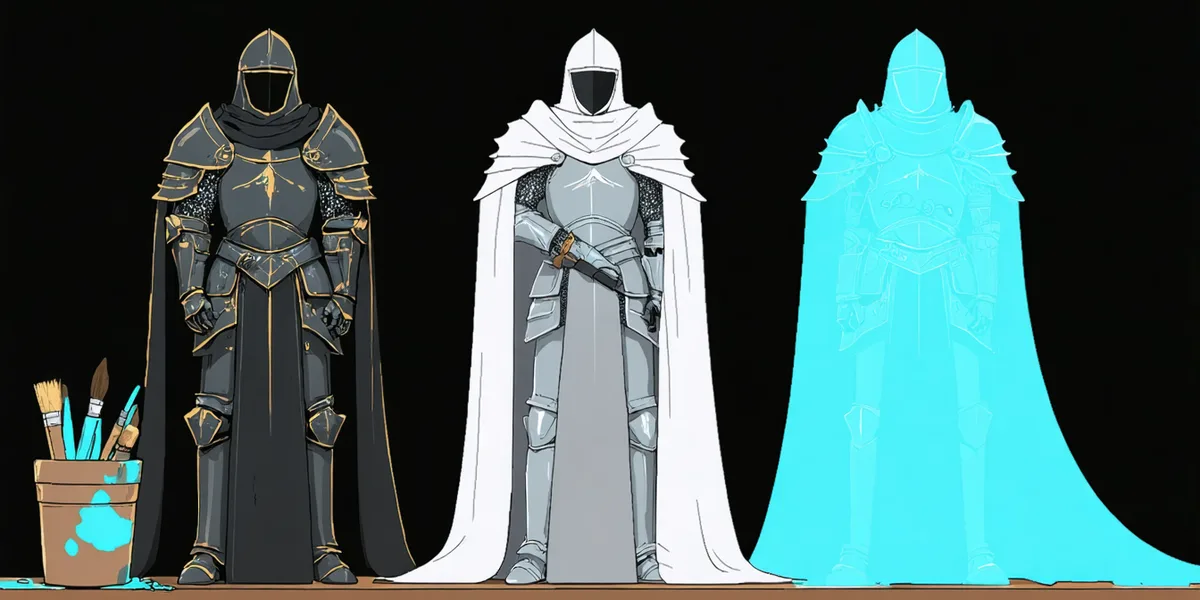
Slapchop is the fastest route from grey plastic to a finished-looking army that has appeared in years. The idea: build all your lighting in monochrome first with a drybrush, then let translucent paints - Citadel Contrast, Army Painter Speedpaint, Vallejo Xpress - turn that lighting into colour in one coat. The shading and highlighting are done before any colour touches the model.
The method
- Prime black. Any matte black primer. This is your darkest shadow.
- Heavy drybrush grey. With a big soft drybrush, work a mid grey over the whole model, hitting everything except the deepest recesses.
- Light drybrush white. A lighter pass of white (or off-white) catching only the upper surfaces and edges - top of the head, shoulders, raised detail. You now have a zenithal sketch: light from above, shadow below.
- Glaze colour over it. Apply contrast/speed paints straight over the drybrushed surface. The paint settles thin over the light areas and pools in the dark ones, so every coat arrives pre-shaded and pre-highlighted.
- Pick out details. Metallics, eyes, gems and anything the glaze muddied get normal opaque paint at the end.
The brushes that make it work
The whole technique lives or dies on the drybrushing, and proper domed drybrushes genuinely matter here - a flat scrubby brush leaves streaks where a dome lays smooth gradients. The Artis Opus Series D set popularised the style; the Army Painter Masterclass drybrush set does the same job for much less. Some painters use soft makeup brushes, which work for the big grey pass but struggle with control on the white one.
Two drybrushes cover it: something large and soft for the grey, something smaller for the directional white pass.
What to know before committing
- It suits texture-heavy models. Cloaks, fur, muscle, rock, ruins - anywhere the drybrush can catch detail. Smooth armour panels show drybrush streaks through the glaze; classic zenithal priming through an airbrush (or rattlecan) handles those better.
- Colours come out muted. The grey underlayer dulls the glaze compared with painting over white. Many painters slapchop the model, then re-glaze or edge-highlight the focal areas.
- It is forgiving, not invisible. Up close you can tell a slapchopped model from a layered one. On the table, at arm's length, across a hundred Skaven - you cannot, and that is the point.
The underlying skill is ordinary drybrushing - if your drybrush control is rough, that guide first. And thin, even glaze coats matter more than usual: flooding a slapchopped model drowns the underlayer you just built (see thinning paints).
Shop drybrushes
A domed drybrush set is the one purchase slapchop actually requires.
Army Painter Masterclass Drybrush Set
Best price
postage per seller
 Buy at eBay
cheapest of 4 UK sellers · save £3.35 vs the most expensive · excl. delivery


We earn a small commission from qualifying purchases at no extra cost to you.