


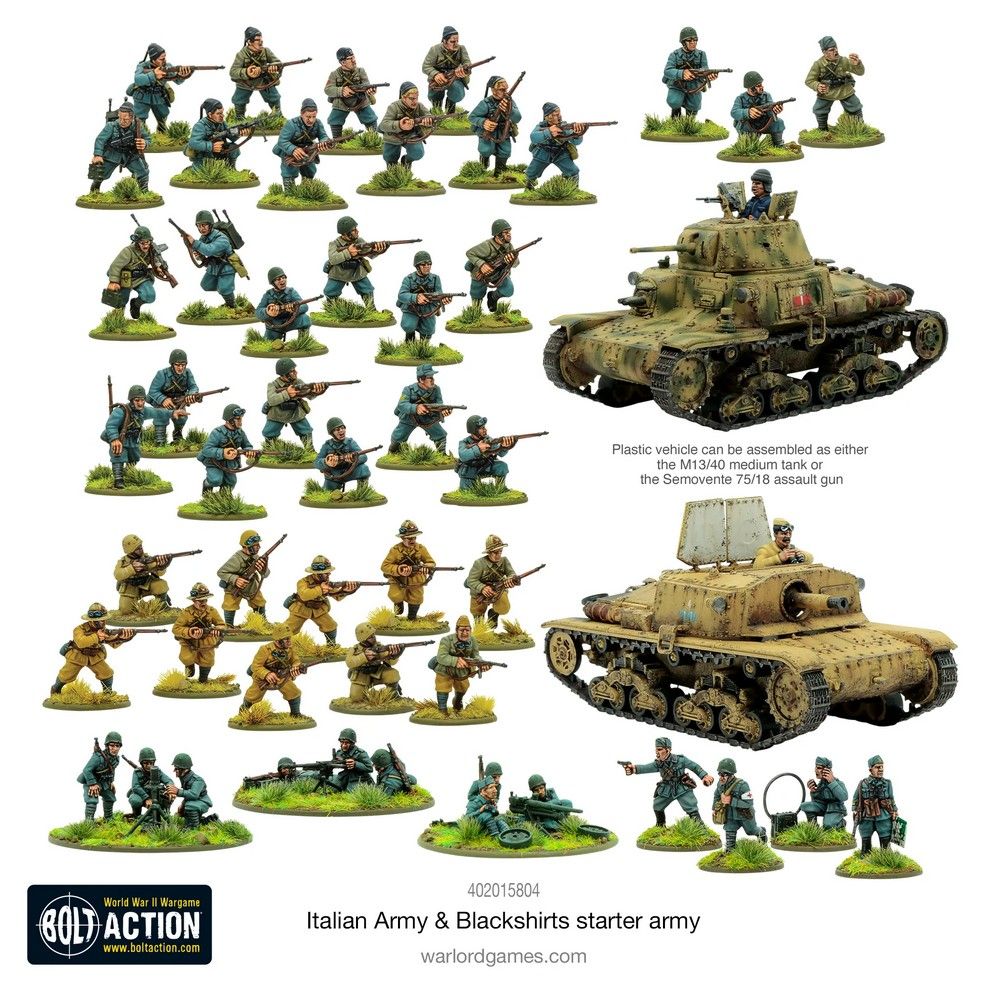
Italians are the grey-green army, and the mistake almost everyone makes is painting them German. Grigio-verde and feldgrau are both desaturated grey-greens, but grigio-verde is markedly lighter, cleaner and greyer - closer to a sage than to a drab - and a squad painted in German cloth reads as Wehrmacht with the wrong helmets on. The second thing to know is that Italy is really two armies in one range: continental troops in grey-green wool, and desert troops in sand-coloured drill. Both are a single base bottle plus a wash, which makes this one of the cheapest nations on the shelf to get onto a table.
The signature look
Grigio-verde tunic, breeches and M33 helmet, all the same tone, against warm brown leather belts, braces and pouches. Almost nothing else competes: no bright facings, no blackened webbing, no pattern on the average rifleman. What carries the character is headgear - the Bersaglieri's spray of black cockerel feathers, the Alpini's felt hat and single feather, the Blackshirt fez - and one telo mimetico item where it belongs.
The grigio-verde uniform
Undercoat grey or black. Grigio-verde is a mid tone and covers happily over either.
- Basecoat Vallejo Model Color Green Grey, two thin coats. This is the reference bottle for Italian cloth and the whole reason the army is quick to paint.
- Shade with Agrax Earthshade in the folds for a warm, dusty result, or Army Painter Military Shade across the garment if you want the grey-green to stay cool. Italians look better dusty than clean, so the warm option is rarely wrong.
- Layer Green Grey back over the raised cloth: the chest, the tops of the shoulders, the front of the thighs and the puttee wraps.
- Highlight with Green Grey mixed two to one with Stone Grey, then a very sparing final catch of Sky Grey on shoulders, elbows and knees.
For an older or greener tunic - and Italian cloth varied a great deal by year and contractor - swap the base for Olive Grey, which sits a step greener and darker. Mixing a drop of Khaki into some pots covers wartime dye variation for nothing.
Citadel equivalent: Death Korps Drab basecoat, Agrax Earthshade, layer Death Korps Drab, highlight Ogryn Camo. It runs browner than true grigio-verde, so keep the highlight grey rather than sandy. Army Painter Fanatic: Uniform Grey with a drop of Army Green in the base, shaded Military Shade, highlighted Ash Grey.
Speed route: undercoat Wraithbone, one coat of Citadel Militarum Green contrast or Army Painter Speedpaint Camo Cloak, then glaze the whole figure with a thinned Nuln Oil to pull the green towards grey and edge the folds in Stone Grey.
Telo mimetico and the sahariana
Italy fielded the first mass-produced camouflage pattern in the world, and it turns up on shelter quarters, helmet covers and the smocks worn by paratroopers and San Marco marines. It is three colours on a light ground: irregular, rounded patches - not shards - of a red-brown and a grey-green over sand.
Base the panel Dark Sand, then lay soft-edged blotches of Cavalry Brown and Camouflage Olive Green across it, letting the two touch in places. Keep every patch smaller than instinct suggests; at 28mm a generous blob reads as a stain. Wash the finished panel with Agrax Earthshade to bring the three colours back into one piece of cloth.
For North and East Africa, swap the wool entirely. Khaki drill and the sahariana jacket go Iraqi Sand basecoat, Agrax Earthshade shade, Dark Sand layer, Pale Sand highlight - four steps, one theatre, the same sculpts. Sun-bleach the helmet with Middle Stone and take the pith helmet's cover almost to Off-White.
Leather, helmets and metal
- Belt, braces, ammunition pouches and pack straps: Cork Brown basecoat, Agrax Earthshade, highlight Cork Brown with a touch of Dark Sand. Italian leather is warm and mid-toned, closer to the French than the German.
- Boots and officers' equipment: Chocolate Brown shaded Nuln Oil, highlighted Beige Brown.
- M33 helmet: exactly the same Green Grey as the tunic, shaded harder with Nuln Oil and caught only on the rim and crown. Matching helmet to uniform is what makes the section look issued.
- Carcano rifles and the Breda 30: Flat Brown stocks highlighted Beige Brown, metalwork Gunmetal shaded Nuln Oil, or Citadel Leadbelcher into Runefang Steel.
- Faces: Basic Skin Tone, Agrax Earthshade, Medium Fleshtone, a touch of Light Flesh.
The sub-ranges
Bersaglieri are the ones everybody recognises: the spray of black cockerel feathers on the right of the helmet. Base them Black Grey, wash Nuln Oil, then drybrush the feather tips Neutral Grey so the mass does not disappear into a black lump.
Alpini wear the felt mountain hat in Green Grey shaded harder than the tunic, with a single black feather and a rope-and-piton kit of Khaki and Gunmetal.
Blackshirts of the militia get the black shirt and fez: Black Grey basecoat, edge-highlighted Neutral Grey, with the fez tassel in Carmine Red. Never pure black - it kills the folds.
Folgore paratroopers in North Africa are the place for sand-coloured jump smocks over grigio-verde trousers, plus telo mimetico helmet covers. The mixed palette is why they look so different from a line squad built from the same sprue.
Vehicles - the AB41 armoured car, the Semovente, the P40 - take a sand base of Iraqi Sand with soft blotches of Camouflage Olive Green and Cavalry Brown, drybrushed Pale Sand on the edges and dusted heavily around the running gear.
Tips and common mistakes
- Lighter than feldgrau. If your Italians could pass for Germans in a photograph, add grey and lighten the base until they cannot.
- Warm brown leather. Against a cool grey-green tunic the brown kit does all the contrast work, so keep it warm and do not darken it.
- One camouflage item. A helmet cover or a shelter quarter, not a whole squad in telo mimetico. The pattern was issued as kit, not as a uniform.
- Pick the theatre before the paint. Grey-green wool or sand drill - mixing them in one section is the fastest way to make an army look unplanned.
- Dust everything. A drybrush of Pale Sand up the puttees and across the pack ties the figure to its base and suits both theatres.
When the palette is settled, open this scheme in the generator to swap brands or trade the grey-green for desert drill.