


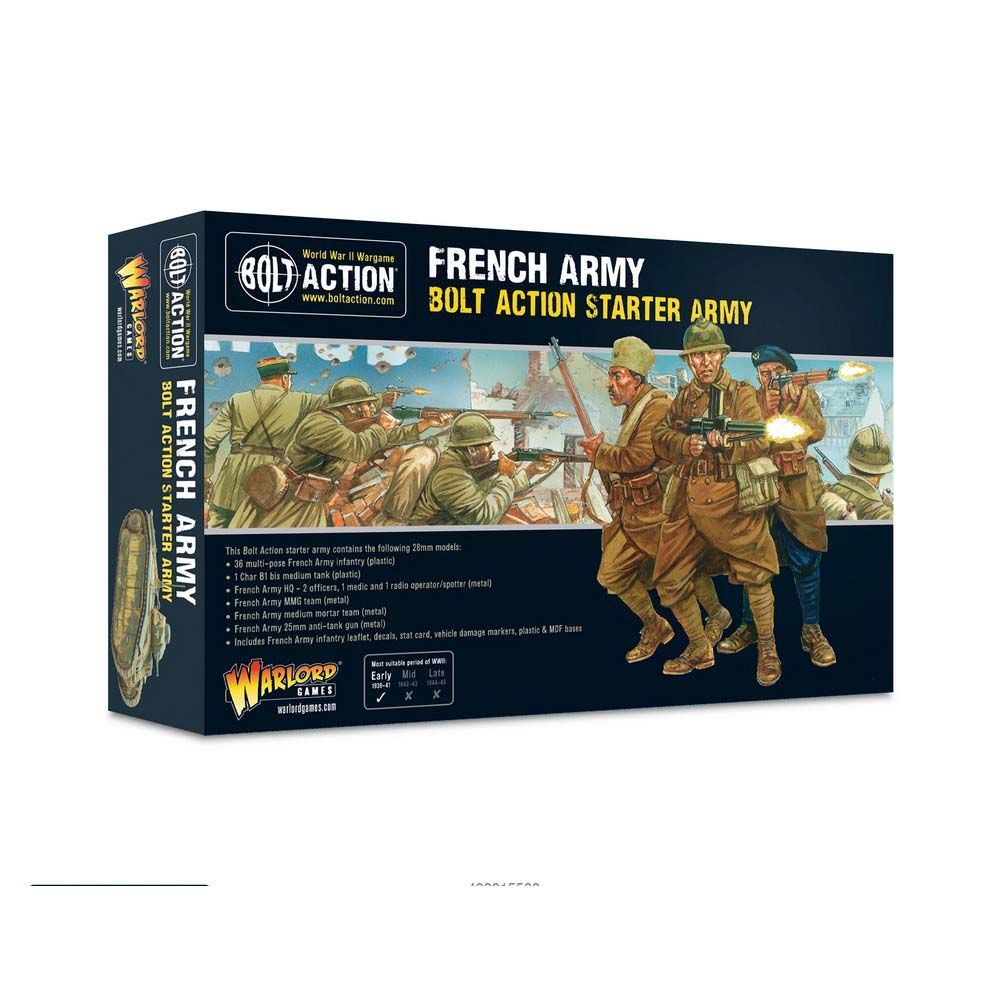
The single most useful thing to know before painting a 1940 French squad is that horizon blue is a First World War colour. The Armee de Terre began replacing it in the 1920s, and by May 1940 the infantryman in front of you is wearing a khaki uniform - a brownish, slightly yellow khaki of its own, not British serge and not American drab. The blue survives in exactly one place a Bolt Action painter cares about: the Adrian helmet, still widely issued in its old blue-grey paint, and on greatcoats and kit held by reserve and colonial units. That single blue-grey note against warm khaki and brown leather is the 1940 look, and it is why the swatch above is a blue rather than a drab.
The signature look
Khaki tunic and breeches, an Adrian helmet in blue-grey with its distinctive ridge and front badge, and leather everywhere - French field kit is belts, braces, cartridge pouches and pack straps in warm natural leather where every other army has canvas webbing. Get those three things right and the figure dates itself to 1940 without a badge in sight.
The 1940 khaki uniform
Undercoat black or dark brown.
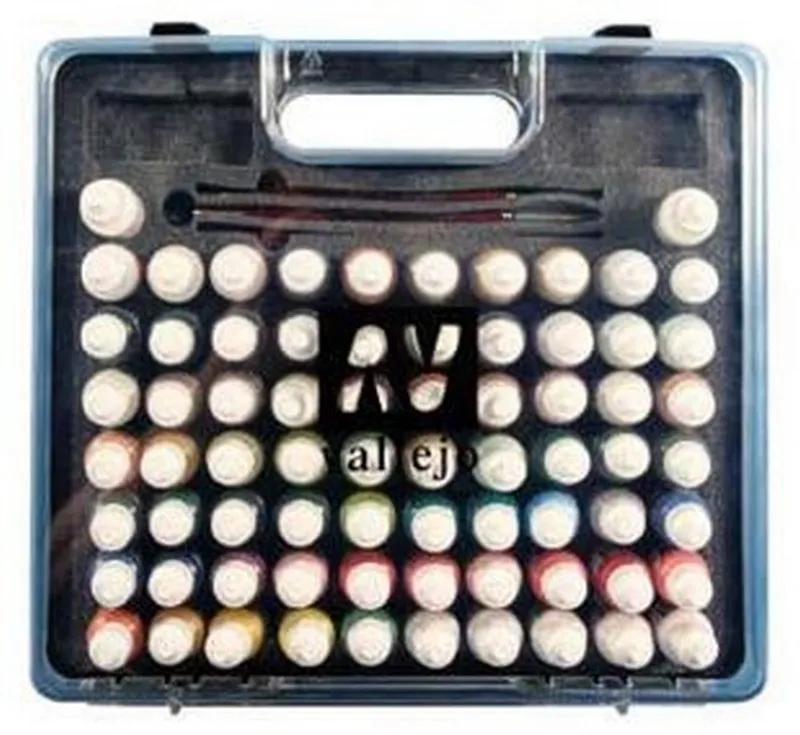
- Basecoat Vallejo Model Color Khaki, two thin coats. It is the closest single bottle to French 1940 cloth: browner than Soviet khaki-olive, yellower than British battledress.
- Shade with Agrax Earthshade in the folds, or Army Painter Strong Tone for the same warm result.
- Layer Khaki back over the raised cloth - the chest of the tunic, the tops of the shoulders, the front of the thighs and the puttee wraps.
- Highlight with Khaki mixed two to one with Dark Sand, then a final sparing catch of Buff on shoulders, elbows and knees.
For the heavy wool greatcoat, which a great many 1940 figures wear, run a slightly greyer version: Khaki Grey basecoat, Agrax Earthshade, highlight Khaki Grey plus Dark Sand. Two related khakis on the same model - tunic and coat, or coat and rolled blanket - is far more convincing than one flat shade.
Citadel equivalent: Zandri Dust basecoat, Agrax Earthshade, layer Zandri Dust, highlight Karak Stone. Army Painter Fanatic: Command Khaki shaded Strong Tone and highlighted Tomb King Tan.
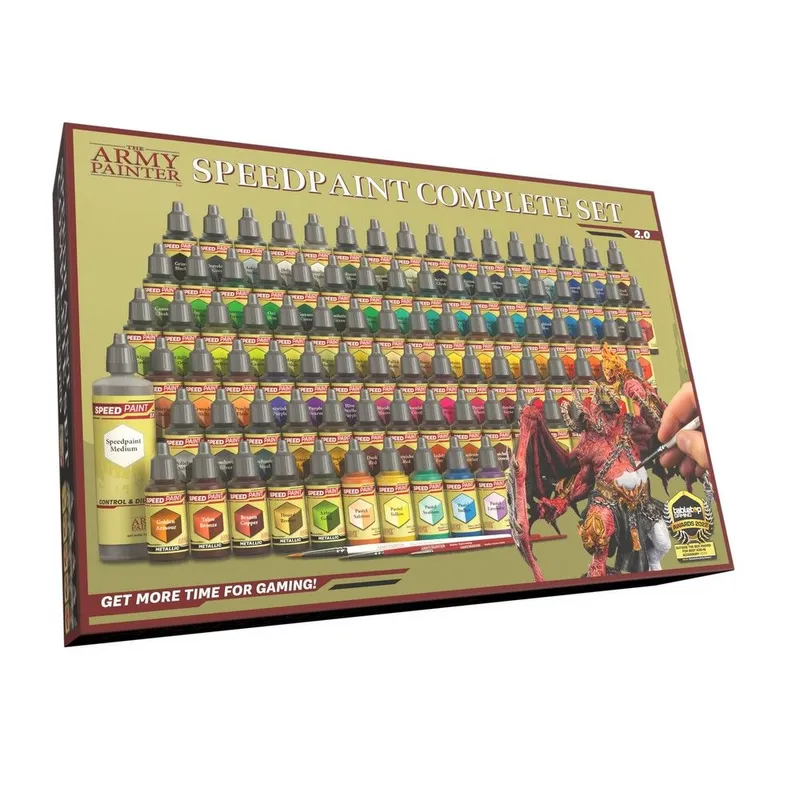
Speed route: undercoat Wraithbone, one coat of Citadel Garaghak's Sewer contrast or Army Painter Speedpaint Desolate Brown, then an edge catch of Dark Sand.
The Adrian helmet and the blue-grey
This is where the horizon blue lives. It is a grey-blue, chalky and desaturated, and it should never look like a bright uniform colour.
- Basecoat Pastel Blue.
- Shade with Nuln Oil in the recess behind the crest and under the front and rear brims.
- Layer Pastel Blue back across the dome.
- Highlight the ridge, the crest and the rim with Pale Grey Blue, then a hairline of the same on the very top of the crest.
Citadel equivalent: Russ Grey basecoat, Nuln Oil, highlight Fenrisian Grey. Army Painter Fanatic: Stratos Blue into Marine Mist. For a helmet repainted khaki - increasingly common through 1940 - simply use the uniform recipe and skip the blue entirely; a mixed squad of blue-grey and khaki helmets is historically right and visually excellent.
The chin strap and the front badge are worth two minutes: strap in Cavalry Brown, badge picked out in Gunmetal and washed Nuln Oil.
Leather and kit
French leather is the other half of the scheme, and it should be noticeably warmer and lighter than German or British kit.
- Belt, Y-braces, cartridge pouches and pack straps: Cork Brown basecoat, Agrax Earthshade shade, highlight Cork Brown with a touch of Dark Sand.
- Boots and the darker officers' equipment: Chocolate Brown shaded Nuln Oil, highlighted Beige Brown.
- Pack and mess tin canvas: Beige Brown shaded Agrax Earthshade, or Khaki Grey for issue canvas.
- MAS-36 and Berthier rifles: Flat Brown stocks highlighted Beige Brown, Gunmetal metalwork shaded Nuln Oil. Citadel: Leadbelcher into Runefang Steel.
- Faces: Basic Skin Tone, Agrax Earthshade, Medium Fleshtone, a touch of Light Flesh.
Variations worth painting
Chasseurs Alpins wear the large dark beret: Dark Blue shaded Nuln Oil, highlighted with Dark Blue plus Grey Blue. Keep it very dark; a bright beret pulls the eye off the whole model.
Colonial and North African units - Tirailleurs, the Foreign Legion, Spahis - are the place for khaki drill and older stocks. Use Iraqi Sand into Pale Sand for drill uniforms, Off-White for Legion kepi covers, and mix in some genuinely horizon-blue greatcoats using the helmet recipe scaled up. This is the only context where a blue garment is defensible on a 1940 table.
Vehicles - Char B1 bis, Somua S35 - carry the three-tone camouflage: Olive Green, Flat Earth and Chocolate Brown in soft patches, separated by thin black dividing lines. Those black lines are the pattern's signature and worth the fine brush.
Tips and common mistakes
- Khaki uniform, blue-grey helmet. Painting the whole figure horizon blue puts him twenty-two years early.
- Warm the leather. Light brown belts and braces against khaki are what make a French figure look French rather than a repainted Tommy.
- Two khakis beat one. Tunic, greatcoat and puttees in slightly different shades reads as real cloth.
- Keep the blue chalky. Add grey, never white, to highlight it. A pure white highlight turns the helmet into porcelain.
- Mud to the knee. These are 1940 figures on the retreat; a drybrushed earth tone up the puttees ties them to the base.
When the palette is settled, open this scheme in the generator to swap brands or trade the blue for an all-khaki late-campaign look.