


Greenskins are a horde army with a horde army's arithmetic: you will paint more models here than in any other Old World force, and the recipe has to survive being done sixty times. Fortunately the signature look is built on a wash and a drybrush, which are the two fastest techniques there are, and every mistake reads as a scar, a scuff or a bad repair.
Paint the skin well and paint everything else quickly. That division is the whole plan.
The signature look
Saturated green skin that darkens hard into the recesses, so a mob reads as muscle rather than as a green blob. Around it, everything is scavenged: unpainted wood, beaten iron gone to rust, mismatched leather, and bone-coloured teeth. Then one loud spot colour - red chequers and zigzag dags on the cloth - which is the tribal marking that ties a mob together and gives the eye somewhere to land.
The orc skin ramp
- Basecoat Waaagh! Flesh, two thin coats. Use Caliban Green underneath instead if you want older, darker orcs.
- Wash the whole model with Biel-Tan Green. This is the step that makes it look like an orc and the step people skip; the green needs to go genuinely dark in the creases.
- Layer Warboss Green on the raised muscle - shoulders, forearms, brow, chest, knuckles.
- Layer Skarsnik Green on the highest points only.
- Characters and bosses: a final catch of Nurgling Green on the brow ridge, nose and knuckles.
Contrast route: undercoat Wraithbone, one coat of Ork Flesh, then drybrush Skarsnik Green. Faster still, and very effective on a big mob: undercoat black, drybrush Warboss Green hard from above, drybrush Skarsnik Green lightly on top, then push Athonian Camoshade into the recesses to knit it together.
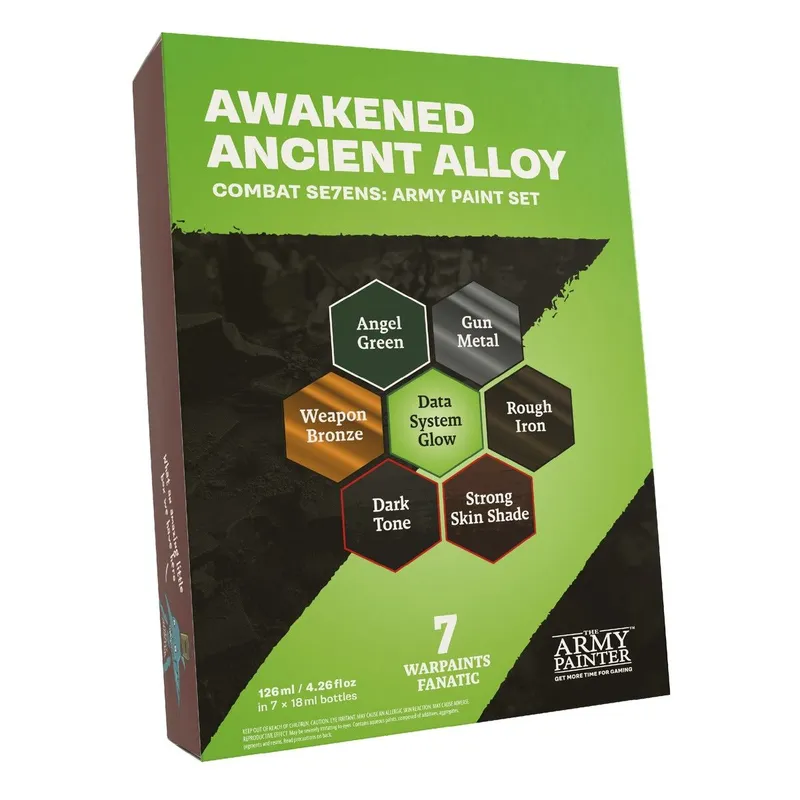
Vallejo painters can run Goblin Green into Sick Green; Army Painter Fanatic gives Greenskin into Angel Green.
Goblins
Goblin skin should be more acidic and yellower than orc skin so the two never look like the same species scaled down. Basecoat Warpstone Glow, wash Biel-Tan Green, layer Moot Green, highlight Nurgling Green.
Night goblins are the exception, and the fastest models in the army: keep the exposed skin dark and put every minute into the hood. Abaddon Black, drybrushed Eshin Grey, edged Dawnstone, with the hood's inner shadow left black. A crescent moon freehanded in Moot Green or Ushabti Bone on the back of the hood turns a black cone into a character.
Teeth, tusks, claws and horns: Rakarth Flesh, Agrax Earthshade, Ushabti Bone, Screaming Skull on the very tips. Never white - white teeth on a greenskin look like dentures.
Ramshackle wood and rusted metal
- Wood on hafts, wagons and choppa handles: Gorthor Brown, Agrax Earthshade, drybrushed Baneblade Brown, then a light Karak Stone on the splintered edges. Wyldwood does the whole job in one coat.
- Iron: Leadbelcher, Nuln Oil, Ironbreaker scraped along the cutting edge only.
- Rust is not optional. Stipple Typhus Corrosion around rivets, blade roots and the lower half of any plate, then stipple Ryza Rust sparingly on top of it. Orc metal should look salvaged; that rust is what separates a greenskin mob from a state regiment carrying the same halberd.
- Leather straps and hide: Rhinox Hide, Agrax Earthshade, Mournfang Brown. Snakebite Leather in one coat for the rank and file.
Red chequers and dags
This is the freehand that makes the army, and it is far easier than it looks because greenskin cloth is supposed to be crooked.
- Base the cloth Zandri Dust, shade Agrax Earthshade, layer Ushabti Bone. A pale cloth gives the red something to sit against.
- Sketch the grid in pencil, following the curve of the fold rather than the flat of the panel.
- Fill alternate squares with Mephiston Red, keeping the brush loaded but not wet.
- Highlight the upper edge of each red square with Evil Sunz Scarlet so the chequers follow the cloth's own light.
For dags - the zigzag hem on banners and tunics - paint a solid band of Mephiston Red along the hem first, then cut triangles out of it with the cloth colour. Cutting notches out of a band is much easier than painting a row of triangles.
If you would rather run yellow tribal markings, Averland Sunset into Casandora Yellow into Flash Gitz Yellow does the same job and reads well against green skin.
Tips and common mistakes
- Shade hard, highlight bright. A timid wash gives you a flat green mob. The contrast between deep recess and bright knuckle is the entire look.
- Vary the green across the unit. Mix a little Zandri Dust or Caliban Green into the basecoat on every fourth model. A mob of identical greens looks moulded; a mob of slightly different ones looks alive.
- Rust everything metal. Clean steel on an orc is the single most common thing that makes a greenskin army look wrong.
- Chequers belong on flat panels. Banners, loincloths, shields and drum skins. Trying to chequer a heavily folded sleeve wastes an hour for nothing.
- Assembly-line the mob. Basecoat and wash all forty, then layer all forty. Chequers get done once, at the end, on the models that face the front.
When you are happy with the palette, open this scheme in the generator to swap paints between brands, nudge the mood or add a secondary colour.