


High Elves are the tidiest scheme in The Old World, and tidy is the hard kind. There is nowhere to hide: white robes show every brush mark, the blue panels are large and flat, and the gold is on show at close range on almost every model. What you get in return is an army that looks expensive from three feet away, because clean is exactly what nobody manages by accident.
The good news is that the model count is low for a rank-and-flank force and the detail is shallow and crisp, which means thin paint behaves. Work slowly on the first ten spearmen and the technique carries the rest of the army.
The signature look
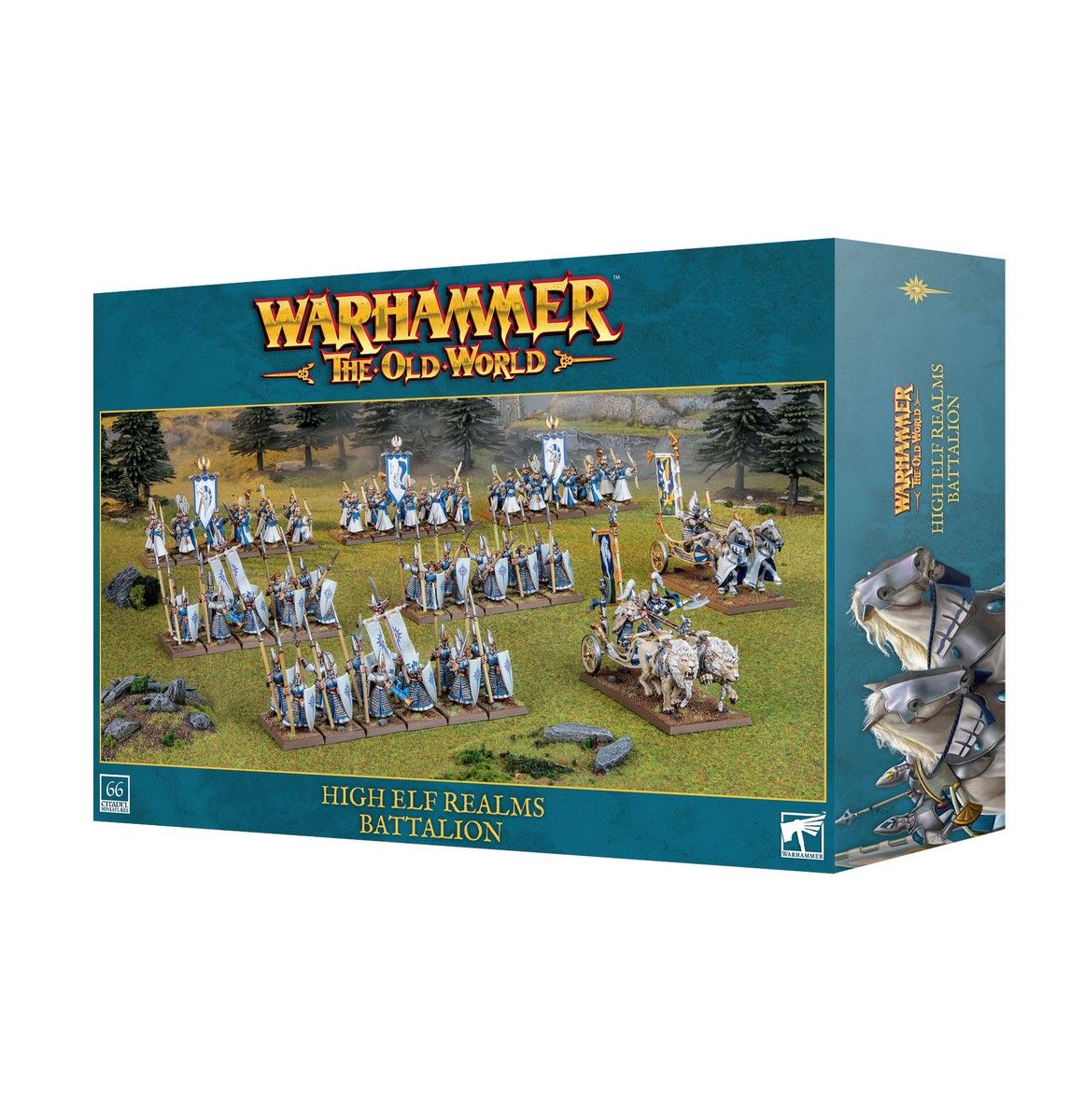
Off-white robes and cloth shaded blue-grey rather than brown, azure blue on shields, helmet plumes and banner fields, warm gold on trim and ithilmar armour, and a small number of jewel-bright gemstones doing the work of a spot colour. The palette is cool throughout, so any warm shadow reads as dirt - and a dirty High Elf reads as a mistake, not as weathering.
The white robes
Undercoat Grey Seer - starting from a mid-grey rather than white saves you two coats of white paint and gives the shading something to sit in.
- Shade the recesses and the base of each fold with thinned Drakenhof Nightshade, applied only where the cloth folds inwards. A brown wash here is what makes white go ivory and grubby.
- Layer Ulthuan Grey across everything except the deepest folds. Two thin coats, and let the first dry properly.
- Layer Celestra Grey back into the mid-tones if the transition looks too abrupt - optional, and only on characters.
- Highlight White Scar on the raised edge of each fold and along the top of every panel. Keep this to genuine high points; white everywhere is white nowhere.
For the fast version, undercoat Wraithbone and give the cloth a single coat of Apothecary White contrast. It shades cool, which is exactly what this scheme wants, and one White Scar highlight on top finishes it.
Azure blue
The Lothern blue on shields, plumes and banners:
- Basecoat Macragge Blue, two thin coats.
- Shade Drakenhof Nightshade so the shadows stay blue.
- Layer Calgar Blue on the raised areas.
- Edge-highlight Fenrisian Grey, with a final Etherium Blue catch on the corner of a shield boss.
For a lighter, more turquoise-leaning azure, basecoat Teclis Blue over Grey Seer, layer Lothern Blue and highlight Baharroth Blue - brighter, faster, and better suited to Lothern Sea Guard than to a Silver Helm. Talassar Blue contrast over Wraithbone gets you close in one coat.
Vallejo painters can run the same ramp as Prussian Blue, Royal Blue and Andrea Blue; Army Painter equivalents are Deep Blue, Crystal Blue and Wolf Grey.
Gold, ithilmar and gems
Trim, helms and ithilmar plate: Retributor Armour, shade Reikland Fleshshade rather than a brown wash - it keeps the gold warm instead of muddy - then layer Auric Armour Gold and put the smallest possible catch of Stormhost Silver on the sharpest corners. For a paler, silvery ithilmar, use Ironbreaker shaded Nuln Oil with Runefang Steel edges.
Gemstones are the spot colour, and they are two minutes of work each:
- Red - Khorne Red in the recess, Evil Sunz Scarlet across the middle, Wild Rider Red at the lower edge, a single White Scar dot at the upper corner, then gloss varnish.
- Blue - Kantor Blue, Macragge Blue, Calgar Blue, same dot.
- Green - Caliban Green, Warpstone Glow, Moot Green, same dot.
Spiritstone Red, Waystone Green and Soulstone Blue over a silver basecoat do the same job in one coat if you have a lot of gems to get through.
Faking non-metallic metal
High Elf gold suits the painted-metal look because the surfaces are large and flat. You do not need full non-metallic technique to get most of the effect: ramp Zandri Dust, Ushabti Bone, Screaming Skull and a White Scar stripe on the topmost edge, keeping every transition sharp and placing the brightest line on one side only. For steel, run Dark Reaper through Thunderhawk Blue and Administratum Grey to a White Scar edge. Pick one light source and stick to it across the whole model.
Skin should stay pale and cool: Rakarth Flesh, Reikland Fleshshade, then back up to Pallid Wych Flesh with a Kislev Flesh touch on the lips.
Tips and common mistakes
- Never shade white with a brown wash. It goes instantly to old parchment. Blue-grey shadow is the whole difference between marble and canvas.
- Two thin coats of white, always. One thick coat leaves ridges that no highlight will rescue, and white is the least forgiving paint you own.
- Let the blue be the smaller area. White dominant, blue as panels and plumes, gold as line work. Reversing that ratio makes them look like a different army.
- One dot per gem. Two dots and it stops reading as a reflection.
- Keep the bases clean and pale too. Stone, sand or grass - churned mud undoes an hour of careful white.
Try the balance of white, azure and gold in the scheme generator before you commit the host.