
Edge highlighting is the single most impactful technique for hard-edged, armoured miniatures. It defines the form by catching the raised edges - corners, panel lips, weapon casings - in a lighter colour, the way real light would fall on real metal and plastic. Done across a whole model it is what separates a flat basecoat from something that reads as sculpted armour from across a table.
It is also one of the more demanding brush-control skills in the hobby, so this guide spends as much time on the mechanics as it does on the paint. The motion takes practice, but the practice is short and the payoff is permanent.
What it is
You drag a lighter version of the base colour along the topmost edges of a surface - the corners, ridges and panel lips that would catch light from above. The base colour stays where it is; you are adding a thin line of something 20-40% lighter directly on the edge, not blending it into the panel. That contrast between a flat mid-tone panel and a crisp light line along its border is what the eye reads as "this is a hard, faceted surface."
It works because real armour, guns and vehicles are full of flat planes meeting at sharp angles, and light grazes an edge while doing almost nothing to the flat face beside it. Edge highlighting paints that behaviour directly, which is why it reads so well on Space Marines, Imperial Guard tanks, Necrons and anything else built from hard panels.
When to choose it over the alternatives
Edge highlighting is one tool among several for adding light and shade, and it is worth being deliberate about which one a given surface calls for:
- Choose edge highlighting for hard, flat-panelled surfaces - armour plates, weapon casings, vehicle hulls, book covers, helmet rims. Anywhere a real edge exists for the light to catch.
- Choose drybrushing instead for texture rather than edges - fur, rope, rubble, chainmail, tank tracks. It catches every raised point across an irregular surface in one pass, rather than deliberate line-by-line work.
- Choose washes and shades first, in most schemes. A wash defines the recesses before you define the edges, so you are not guessing how much contrast the model still needs.
- Choose wet blending instead when the surface is soft rather than hard - cloaks, skin, banners, anything that should show a gradient rather than a line.
- Choose non-metallic-metal painting when the surface is a large, mirror-flat metal plate, not just a trimmed edge. NMM shares the brush control but takes the contrast much further, treating the whole surface as a ramp rather than just its border.
Most painted models use several of these on different parts of the same figure: a wash in the recesses, edge highlights on the armour, a drybrush on the fur trim, and a wet blend on the cloak. See the techniques guide for how the full set fits together.
What you need
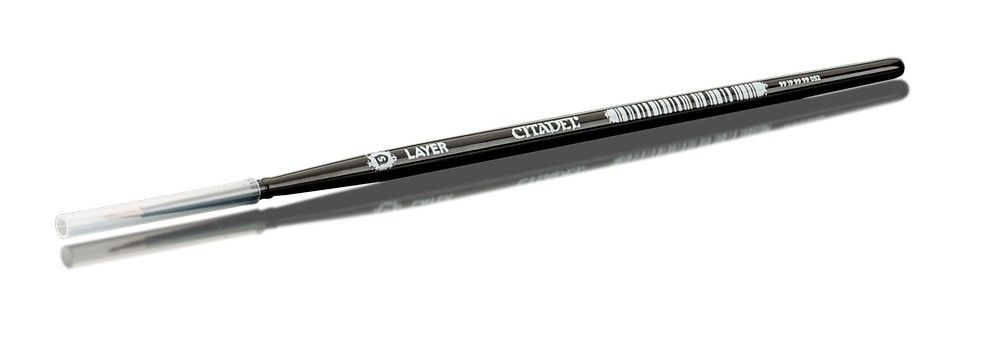
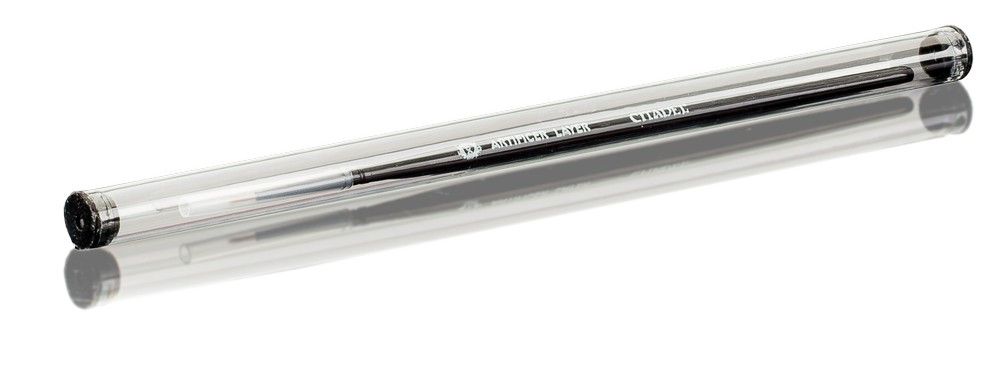
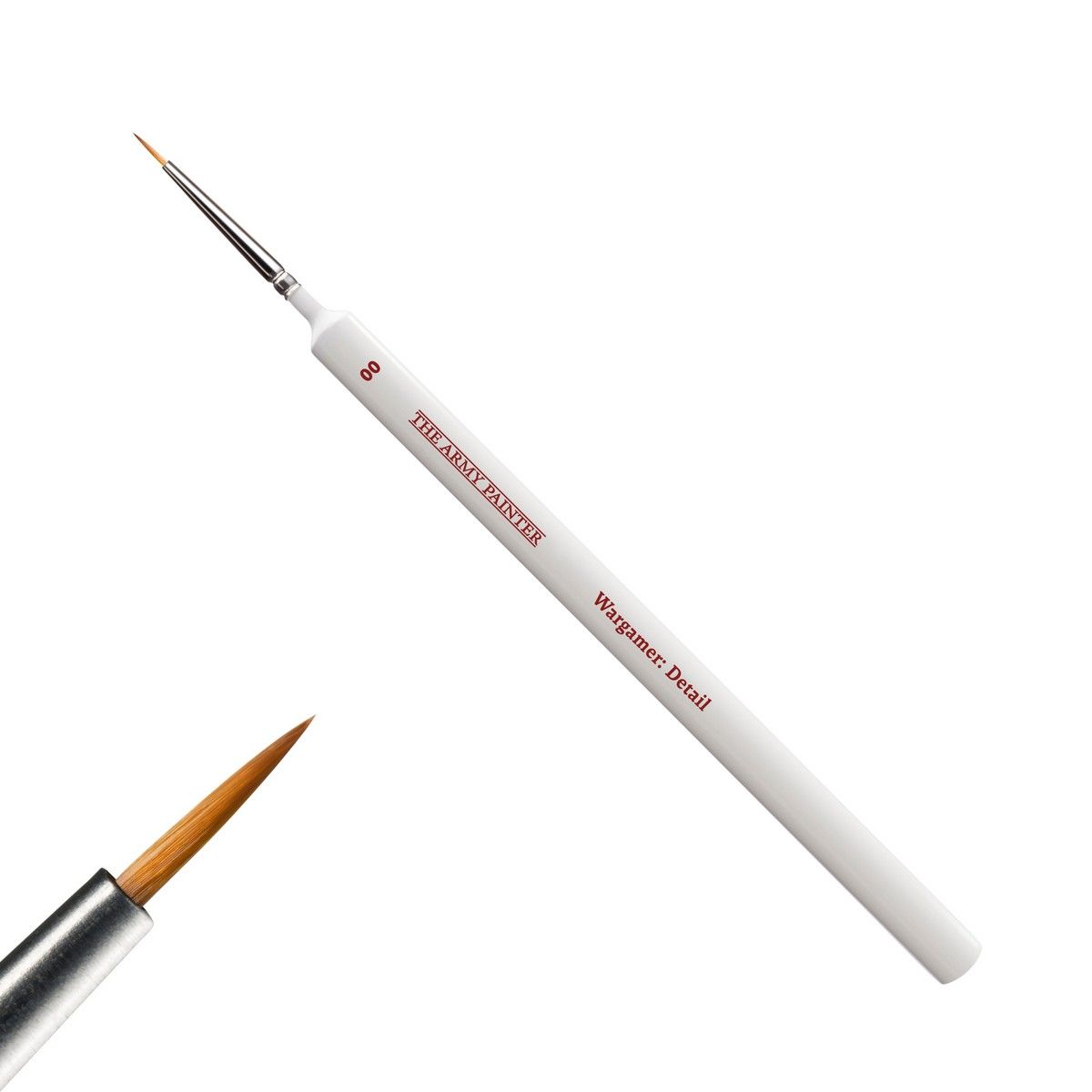
- A fine, well-pointed brush. This is the one technique where brush quality genuinely changes the result - a size 0 or 1 with a real tip is the minimum, and a size 2/0 is worth having for the finest final highlights.
- Thinned paint, roughly the consistency of milk, so it flows off the tip rather than dragging. See how to thin paints if this is new to you. If a thinned line still feels unmanageable, start closer to full strength for more control and thin further as your confidence grows.
- A steady rest for your hand - arm braced on the table, model rotated to meet the brush rather than the other way round.
- Good light, ideally daylight-balanced, so you can see the edge you are aiming for.

Step by step
- Finish the basecoat and wash first. Edge highlighting is the last stage of colour work on a surface, applied over a clean, dry basecoat that has already had its recess wash.
- Thin your highlight colour to a smooth, slightly milky consistency so the line flows rather than drags.
- Load the brush and wipe the excess on a paper towel or your palette until the bristles come to a fine point. You want just enough paint in the tip for one confident stroke, not a reservoir.
- Rest the brush at a low angle, almost flat to the surface, rather than holding it upright like a pen. Lay the side of the tip against the raised edge so the bristle's belly - not its point - makes contact.
- Drag the brush along the edge in one smooth, short motion. Pull towards you or across, whichever direction your wrist controls best; do not push the brush away from you, which flicks the tip and loses the line.
- Work short sections rather than one long edge. A pauldron rim is usually two or three short strokes, not one continuous sweep. Overlap the joins lightly.
- Let it dry fully, then assess. A single highlight coat is often too thin to read at a distance - a second, equally thin coat over the same line will look cleaner than one thick pass.
- Do a second, finer highlight only on the sharpest points - the very corner of a pauldron, the leading edge of a blade, the top of a helmet crest - in a colour one step brighter still, or the same colour applied even more finely. This is what separates a good edge highlight from a great one.
- Check the whole model from arm's length. Edge highlights are a "read from a distance" effect; step back periodically rather than judging only under magnification.
- Fix any highlight that has crept onto the flat panel with a thin glaze of the base colour over the mistake, then redo the line.
Practice exercise before a real model
Do not learn this brush motion on a model you care about. Take a spare sprue offcut or a primed strip of card and paint a simple armoured shape on it - a rectangle standing in for a pauldron, with one raised edge along the top.
- Basecoat the whole shape in a mid-tone.
- Practise the loaded-brush, wiped-tip, low-angle stroke along the top edge ten times, wiping back to basecoat between attempts.
- Aim for a line that is consistently the same width along its whole length - that consistency is what a wobbly first attempt is usually missing.
- Once the line is even, try the second, finer highlight on just the two end corners.
Twenty minutes on scrap plastic saves far more time than it costs, because the model you actually care about becomes your second attempt rather than your first.
Choosing the colour
The scheme generator will build a ready-made highlight tone for any base colour you give it, cross-referenced against the ranges we track. As a manual rule: lighten the base colour and desaturate it slightly rather than adding pure white directly. Going too bright or too saturated makes a highlight look chalky and separates it from the base colour instead of reading as the same surface catching light.
Cross-brand recipes
These are three-step ramps - base, mid highlight, fine edge highlight - built from ordinary matte paints in four ranges. Any one range is enough on its own; they are grouped here because a lot of painters have pots from more than one drawer. Working from a colour that isn't listed here? The paint matcher finds the nearest match in another range.
Red armour
- Citadel: Khorne Red base, edge highlight with Mephiston Red, then a fine final line of Wild Rider Red on the sharpest corners only.
- Vallejo: Dark Red base, highlight with Red, fine edge in Bright Red.
- Army Painter: Dragon Red base, highlight with Wyrmling Red, fine edge in Pure Red.
- AK Interactive: Blood Red base, highlight with Red thinned right down for the finest line.
Citadel (Warhammer Paints)
Citadel (Warhammer Paints)
Vallejo
Vallejo
Army Painter
Army Painter
Blue armour
- Citadel: Macragge Blue base, highlight with Calgar Blue, fine edge in Lothern Blue.
- Vallejo: Ultramarine Blue base, highlight with Magic Blue, fine edge in Electric Blue.
- Army Painter: Ultramarine Blue base, highlight with Crystal Blue, fine edge in Ice Storm.
- AK Interactive: Dark Blue base, fine edge in Sky Blue.
Citadel (Warhammer Paints)
Citadel (Warhammer Paints)
Vallejo
Vallejo
Army Painter
Army Painter
Black armour
Black is the hardest colour to highlight cleanly because the jump from black to any grey is already large - keep the mid-step close to the base and save the biggest jump for the final, smallest line.
- Citadel: Abaddon Black base, highlight with Eshin Grey, fine edge in Dawnstone.
- Vallejo: Black base, highlight with German Grey, fine edge in Light Grey.
- Army Painter: Matt Black base, highlight with Uniform Grey, fine edge in Ash Grey.
- AK Interactive: Black base, fine edge in Ash Grey.
Citadel (Warhammer Paints)
Citadel (Warhammer Paints)
Vallejo
Vallejo
Army Painter
Army Painter
Common mistakes and fixes
- The line wanders onto the flat panel. Usually the brush is held too upright, so the point rather than the belly is doing the work. Flatten the angle and let the bristle's side ride the edge.
- The highlight looks patchy or broken. The paint was too thick, or too little was loaded and it ran out mid-stroke. Thin it further and reload between short sections.
- Highlighting straight to white. A pure white line on a coloured base looks like a scratch, not light. Go through an intermediate step first, and save the brightest colour for the sharpest points only.
- One flat, even highlight along the whole model. Real light is not even - the sharpest corners deserve a second, finer highlight the rest of the edge does not get.
- Working on a wobbly hand-hold. Brace the model hand and the brush hand against each other or against the table.
- Starting on the model. Ten minutes on scrap plastic fixes more first-attempt wobble than any amount of thinking about it does.
Questions people ask
Why is edge highlighting so hard? Because it is pure brush control rather than colour theory - a steady hand dragging a fine, loaded line along an edge, with no blending or large area to hide a shaky pass in. Most of the difficulty disappears with practice on scrap plastic before you touch a real model.
What paint should I use for edge highlighting? Whatever thins well and holds a fine point when loaded - most mainstream acrylic ranges work, including Citadel, Vallejo, Army Painter and AK Interactive. The paint matters less than thinning it correctly and using a brush that keeps its tip.
How thin should the paint be? Roughly the consistency of milk - it should flow off the brush in a controlled line rather than dragging, but not be so thin it has no colour strength and needs four coats.
What is the best brush size for edge highlighting? A size 0 or 1 with a genuine point is the sweet spot for most edges, with a 2/0 worth keeping aside for the finest final lines. Brush quality matters more here than in most techniques - cheap bristles lose their point fast, whatever the size. See best brushes for miniatures.
Why does my highlight look chalky? Usually too much white mixed in, or too large a jump in one step. Desaturate the highlight slightly rather than just lightening it, and split a big jump into two smaller steps.
Should I edge highlight before or after the wash? After. Wash first so the recesses are already defined, then edge highlight over the dry result - doing it the other way round means guessing how much contrast the model still needs. The two do different jobs and work best together: the wash defines the shadows, the highlight defines the light.
Brushes for edge highlighting
A fine, well-pointed brush makes edge highlighting far easier.
Winsor & Newton Series 7 Kolinsky Sable (Size 1)
Best price
priced 25 Sep · free UK mainland delivery over £100, £2.50 over £50, from £4.50 below that
cheapest of 3 UK sellers · save £2.49 vs the most expensive · excl. delivery
We earn a small commission from qualifying purchases at no extra cost to you.