
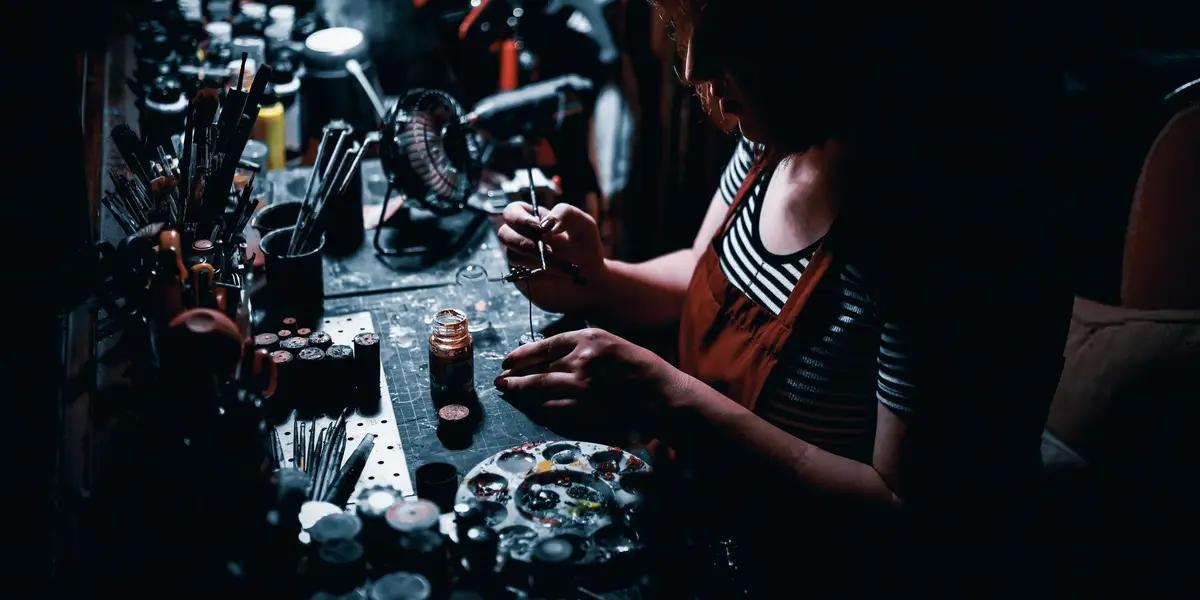
Miniature painting uses a wide range of techniques, from basic approaches every beginner learns to advanced methods that create display-quality results. This guide is a quick reference to the most common ones - several have their own in-depth guide linked below.
Base coating
The first step of almost every paint job: applying a solid, even coat of colour over your primed miniature. The goal is full, opaque coverage with no primer showing through. Use base paints (high pigment, good coverage) in thin coats - two thin coats always look better than one thick one. See how to thin your paints.
Layering
Layering builds highlights by painting progressively lighter colours onto raised areas while leaving darker colours in the recesses. Each layer covers a slightly smaller area than the last, creating a smooth transition from shadow to highlight. Use thinned layer paints and be patient - multiple thin layers beat one rushed one.
Dry brushing
A fast highlighting technique: load a brush, wipe most of the paint off, then drag the near-dry brush across raised surfaces so the remaining paint catches on edges and texture. Excellent for fur, chainmail, stone and rust. Read the full drybrushing guide.
Washing / shading
Washes (shades) are thin, highly pigmented paints that flow into recesses and panel lines, instantly adding depth and definition. Often called "liquid talent" because a single wash dramatically improves a model with minimal skill. Read the full washes and shades guide.
Edge highlighting
Painting a thin line of lighter colour along the sharp edges of armour, weapons and hard surfaces to simulate catching light. Use the side of a fine brush and drag along the edge. Read the full edge highlighting guide.
Wet blending
Applying two or more colours while wet and blending them directly on the model for smooth, seamless transitions - ideal for cloaks, large panels and power swords. Read the full wet blending guide.
Glazing
Extremely thin, transparent layers that subtly shift the colour or tone of what's underneath. Unlike a wash, a glaze is applied in a controlled, directional way. Perfect for smoothing transitions, tinting (a red glaze over skin for warmth), or unifying a scheme. Thin heavily - you should barely see each coat.
Contrast paints
Contrast paints (Citadel Contrast, Army Painter Speedpaint, Vallejo Xpress Color) provide a base, shade and highlight in one application. They are translucent and self-shading - thick in recesses, thin on raised areas. Apply over a light or zenithal primer. Excellent for speed-painting armies and organic textures like skin and cloth.
Stippling
Dabbing paint onto the surface with the tip of the brush in a dotting motion rather than strokes, creating a textured, mottled effect ideal for weathering, rust and organic textures. Use an old or dedicated stippling brush.
Zenithal priming
Priming that pre-establishes light and shadow before any colour: black all over, then white or grey sprayed from above. Thin or translucent paints over the top let the underlying values show through for instant depth. Essential for contrast and slapchop workflows.
OSL (object source lighting)
Simulating a light source on the model itself - a glowing sword, plasma coil or torch - by tinting nearby surfaces with the light's colour and brightening them closer to the source. An advanced effect; start subtle.
NMM (non-metallic metal)
Painting metallic surfaces using only regular paints, simulating reflections with carefully placed light and dark tones instead of metallic pigment. One of the hardest techniques to master, but stunning on display pieces.
Weathering
Adding realistic wear: chipped paint (sponge chipping), rust (stippled oranges and browns), mud, dust (pigment powders) and oil streaks (enamel washes). Turns a clean paint job into something that tells a story.
Airbrushing
Spraying paint as a fine mist for ultra-smooth gradients and even base coats. Ideal for vehicles, large models, zenithal priming and pre-shading. The learning curve is thinning, air pressure and cleaning, but it speeds up batch painting hugely.
Slapchop
A speed-painting workflow: prime black, heavy drybrush grey, lighter drybrush white, then apply contrast paints over the top. The drybrushed highlights show through the translucent contrast for a shaded, highlighted result with minimal effort.
See these techniques in action on community palettes.